UK Footwear AI Visibility 2026 — Part 1: The 10-Brand Ranking
Part 1 of 4. Today: the ranking. Coming up - the playbook, the per-model breakdown, and the v2 corpus expansion.
When a UK shopper asks ChatGPT, Claude, Perplexity or Gemini "what's the best UK shoe brand?", which names actually come up? We ran the question 10 different ways across all four models - 400 prompts in total - and scored every UK shoe brand mentioned. The result is the first AI Visibility ranking for UK footwear in 2026, and a few of the placements will annoy people.
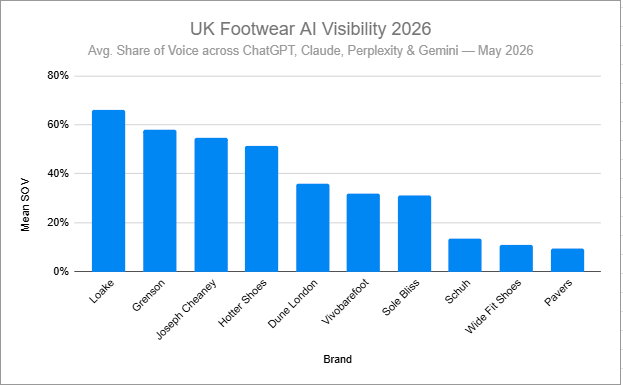
The full ranking, averaged across ChatGPT, Claude, Perplexity and Gemini, May 2026.
Methodology
We picked 10 queries a real UK shopper would actually type:
- best UK shoe brands 2026
- best British shoe brands online
- best UK footwear brand for everyday wear
- best UK heritage shoemaker
- best UK comfort shoes
- best UK wide-fit shoes
- best premium British shoes
- where to buy quality British shoes online
- best British shoemaker for men
- best UK women's shoe brand
Each query went to ChatGPT, Claude, Perplexity and Gemini (4 × 10 = 40 prompts per brand audit). Brands cited get a Share of Voice score: cited by name = 100, partial / generic = 50, not cited = 0. We averaged across all models and queries for the final SOV %.
The ranking
| Rank | Brand | Mean SOV |
|---|---|---|
| 1 | Loake | 66% |
| 2 | Grenson | 58% |
| 3 | Joseph Cheaney | 54.5% |
| 4 | Hotter Shoes | 51.5% |
| 5 | Dune London | 36% |
| 6 | Vivobarefoot | 32% |
| 7 | Sole Bliss | 31% |
| 8 | Schuh | 13.5% |
| 9 | Wide Fit Shoes | 11% |
| 10 | Pavers | 9.5% |
Three findings
1. Heritage dominates
Loake, Grenson and Joseph Cheaney - three Northamptonshire shoemakers with a combined 300+ years of history - take the top three slots, and it isn't close. AI models lean hard on long-form editorial (Financial Times, Telegraph, Permanent Style, GQ), and heritage brands have been written about for decades. The training corpus rewards the brands the press has been describing since before any of these models existed.
2. Hotter Shoes is the outlier
Sitting at #4 with 51.5%, Hotter is the only non-heritage brand in the top tier - which is the interesting result here. Years of comfort-and-value marketing earned it a deep bed of consumer review coverage, and the models surface it confidently the moment a query mentions "comfort" or "everyday wear." That's earned mention density doing exactly what the heritage brands' editorial coverage does.
3. Retailers are nearly invisible
Schuh (#8) and Wide Fit Shoes (#9) are sizeable UK retailers stocking dozens of brands. But AI shoppers asking "where to buy quality British shoes" get pointed overwhelmingly at brand DTC sites, not retailers. If you're a UK footwear retailer, that's not a small gap - AI search is a structural blind spot for you in 2026, and it won't fix itself.
What this means for brands
AI search is becoming a real share of pre-purchase research, especially for considered buys like £200+ shoes. If you don't show up when a shopper asks the AI, you're not on the shortlist - and unlike Google, there's no "page 2" to scrape a click from. You're either in the answer or you're invisible.
- Top 4 (Loake, Grenson, Cheaney, Hotter): defend the lead. Keep producing the editorial-quality content that earned it - this position decays if you stop feeding it.
- Mid (Dune London, Vivobarefoot, Sole Bliss): the gap is closable with a focused 90-day push - structured FAQ content, schema, and earned press in the publications AI models already trust.
- Bottom (Schuh, Wide Fit Shoes, Pavers): the gap to the top widened in our tests. Closable, but only with coordinated work - not a weekend schema fix.
We'll re-run this ranking quarterly to track who actually moves.
Part 2 next week: the 90-day playbook for each tier. Subscribe to get notified when it lands.
This ranking covers 10 UK shoe brands chosen from a starting corpus of mid-market and direct-to-consumer makers. Early reader feedback flagged gaps in our coverage of traditional heritage shoemakers (Crockett & Jones, Trickers, Church's, Edward Green, John Lobb, Solovair) and mass-market brands (Clarks, Dr. Martens). v2 (Q3 2026) expands the corpus to 20+ brands. If you'd like your brand included in v2, email us.
Methodology details: queries run on 14 May 2026. Models used: ChatGPT (GPT-4o), Claude (3.5 Sonnet), Perplexity (sonar-large), Gemini (1.5 Pro). Same 10 queries fired into each model; brand citations scored 100 / 50 / 0; results averaged across queries and models.
Cite this research: Birman, A. (2026). The Mention-Density Model: How AI Search Cites Mid-Market E-Commerce Brands. Zenodo. https://doi.org/10.5281/zenodo.20379032
GEOlikeaPro helps brands measure and improve their AI Share of Voice across ChatGPT, Claude, Perplexity and Gemini - the same methodology we used in this ranking, run continuously for any brand or category. See how it works.
FAQ
Which UK shoe brand is most visible to AI in 2026?
Loake. Across 400 prompts to ChatGPT, Claude, Perplexity and Gemini, Loake achieved a mean Share of Voice of 66%, the highest of any UK shoe brand we tested. Grenson came second at 58% and Joseph Cheaney third at 54.5%. All three are Northamptonshire heritage shoemakers, reflecting decades of editorial coverage that AI models have ingested as part of their training corpora.
How was AI Share of Voice measured?
We ran 10 representative shopper queries against four AI models (ChatGPT, Claude, Perplexity, Gemini) for each brand, totalling 40 prompts per brand. Each citation scores 100 if the brand is named directly, 50 if mentioned partially or generically, and 0 if not cited at all. Scores are averaged across queries and models to produce a single mean Share of Voice percentage.
Why do heritage shoemakers dominate the ranking?
AI models lean heavily on long-form editorial coverage from publications like the Financial Times, Telegraph, Permanent Style and GQ. Loake, Grenson and Joseph Cheaney have decades of such coverage, which is reflected in the training corpus and therefore in their model outputs. Younger brands with weaker editorial trails rank lower regardless of product quality or commercial performance.
Why are UK shoe retailers like Schuh ranked so low?
AI models surface DTC brands when asked for product recommendations, not retailers. Even prompts like 'where to buy quality British shoes online' return brand sites, not multi-brand stockists. This is a structural AI search blind spot for UK retailers in 2026 — and one that is unlikely to close without dedicated retailer-side content and structured data investment.
Does a low AI Share of Voice mean a brand is failing commercially?
No. AI Share of Voice measures only how frequently and prominently a brand is cited by AI models in response to category queries. It does not measure product quality, commercial performance, customer satisfaction, or growth trajectory. Brands at the bottom of the ranking can still be highly successful businesses; the ranking simply highlights a gap in their AI search visibility.
How often will this ranking be updated?
Quarterly. The same 10 queries are re-run against the same four AI models each quarter, with results published so brands and the wider industry can track changes in AI Share of Voice over time. We will also expand the ranking to cover additional UK categories in upcoming quarters.