Apparel DTC's Agent-Readiness Edge Is Just Wikipedia
Four apparel brands scored higher than any beauty brand did - 4 of 9 against a ceiling of 3. So I went looking for what those four built to earn the extra point, and the honest answer is nothing. They are just famous enough to have a Wikipedia entry, and the checker counts it. The rest of the ten I tested - Buck Mason, Rhone, Vuori, the closet staples - sit exactly where beauty did, on whatever Shopify hands them for free.
Top score 4 of 9, reached by four brands. The only thing separating them from the 3-of-9 pack is a Wikidata entity, which tracks whether you are notable enough to be written about, not what you built.
Agent protocols any brand self-hosted: still zero. The one custom-stack brand scored 0 of 9. And eight of ten block a meaningful share of AI crawlers, one of them all twenty.“Rather than fighting against the rising tide of AI‑based search engines and agentic tools, Kolar said publishers and retailers should actually be creating content that can speak directly to these bots (and thus the LLMs generating new forms of traffic). And site owners should also update their robots.txt files to avoid restrictions on crawlers that will diminish the site’s visibility to AI engines.”
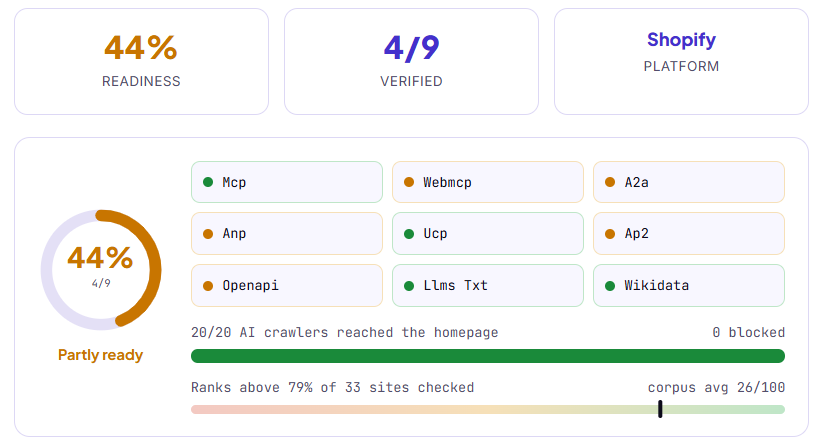
This is the same nine-signal check I ran on beauty, where I broke down what each protocol is and linked every spec - see the beauty batch for that walkthrough. On apparel it lands like this.
| Brand | Platform | Agent readiness | AI crawlers reachable |
|---|---|---|---|
| Faherty | Shopify | 4 of 9 | 20 of 20 |
| Outdoor Voices | Shopify | 4 of 9 | 10 of 20 |
| Marine Layer | Shopify | 4 of 9 | 9 of 20 |
| Alex Mill | Shopify | 4 of 9 | 9 of 20 |
| Vuori | Shopify | 3 of 9 | 20 of 20 |
| Taylor Stitch | Shopify | 3 of 9 | 9 of 20 |
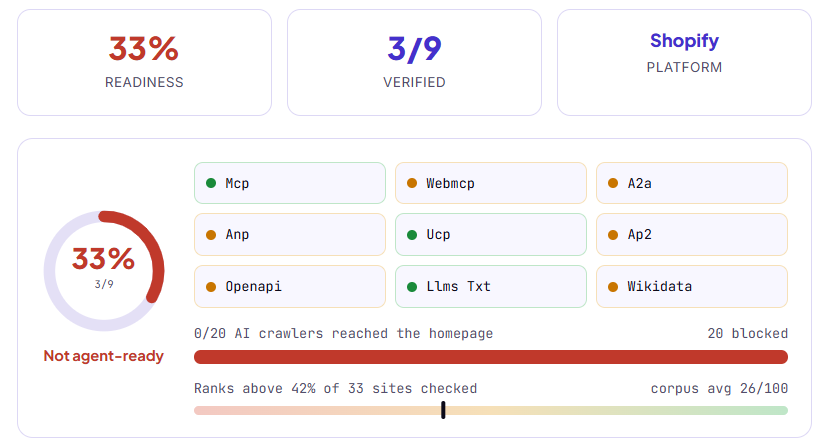
| Rhone | Shopify | 3 of 9 | 0 of 20 |
| Buck Mason | Shopify | 2 of 9 | 6 of 20 |
| Cuts | Shopify | 2 of 9 | 3 of 20 |
| Mizzen+Main | Custom | 0 of 9 | 0 of 20 |
Nine of the ten run on Shopify and inherit the same base: a platform-managed storefront MCP, UCP, and for most an auto-generated llms.txt, all shipped at the platform level per Shopify's agentic commerce docs. Buck Mason and Cuts drop to 2 of 9 because their llms.txt is missing. Every self-hosted signal - WebMCP, A2A, ANP, AP2, OpenAPI - is empty across all ten. So the floor is 3, and the ceiling, for now, is 4.
The extra point is a Wikipedia entry, not code
"Wikipedia is the most important infrastructure asset in modern PR — and most brands treat it like a marketing channel. It isn't. It cannot be bought. It must be earned through the same third-party coverage that earns every other form of authority."
Faherty, Outdoor Voices, Marine Layer and Alex Mill each clear 4 of 9, and they share exactly one thing the 3-of-9 pack lacks: a Wikidata entity the checker can match to their domain. That is the entire gap between the top of the table and the middle.
Wikidata records track notability. A brand gets one because it has been written about, not because it configured anything. So the four leaders did not out-engineer the rest - they are simply better known, known enough for an encyclopedia to list them. Take that fame away and apparel sits on the same Shopify floor as everything else. It is also the one signal on the whole checklist you can go create for yourself: if your brand has press or a Wikipedia page, you probably meet the bar.
Strip the fame and it is the Shopify floor
Mizzen+Main is the proof. It runs a custom stack instead of Shopify and scores 0 of 9 - no inherited MCP, no UCP, no llms.txt, no Wikidata match. Off-platform you start from nothing, and none of these brands had built the basics by hand. What that build actually involves, platform by platform, is in the platform requirements piece.
Rhone passes three checks and blocks all twenty crawlers
The scores also hide who an agent can reach at all. Rhone verifies 3 of 9 on protocols, then returns a 403 to all twenty AI crawler user-agents I tested, so an agent cannot open the store those protocols describe. Cuts lets three of twenty through, Buck Mason six, and only Faherty and Vuori allow all twenty. The block is almost always an edge or WAF rule rather than a decision - several of these stores sit behind Cloudflare's default AI-crawler blocking. It is the same reachability failure the checkout mechanics piece covers one layer down, at the transaction.
What actually moves an apparel brand's score
- Get the Wikidata entity. It is the single point between the leaders and the pack, and it costs nothing to create. Press coverage or a Wikipedia mention usually clears the bar.
- Stop returning 403 to the crawlers. Rhone is the cautionary tale: three checks passed, zero agents able to read them. Your Cloudflare AI-crawler setting and WAF are where this hides.
- Do not delete your Shopify llms.txt. Buck Mason and Cuts lost theirs and sit at 2 of 9 for it. The platform gives it to you free.
- Self-host one real signal to break past 4. A WebMCP tool surface, an OpenAPI doc, an agent card - every one is unclaimed across all ten brands, so any of them puts you first in the category.
- On a custom stack, plan to build from zero. Mizzen+Main inherits nothing; off Shopify the whole checklist is yours to ship.
Ten brands, one vertical, checked August 30, 2026. Small sample, and the numbers move - a brand can register a Wikidata item or restore an llms.txt tomorrow and climb. Treat this as one category on one day, and re-run any brand yourself for its current score.
Beauty capped at 3 with nothing of its own; apparel reaches 4 on borrowed fame. Same floor, same untouched ceiling, one vertical over. The first apparel brand that self-hosts a real agent signal stops sharing a score with the whole category - the way that compounds is in the pillar guide.
Check your store with GEOlikeaPro's agent-readiness checker and see whether an agent gets past 3 of 9 on you.
FAQ
Why do the top apparel DTC brands only reach 4 of 9?
In our test of ten apparel DTC brands on August 30, 2026, the four highest all scored 4 of 9, with the rest at 3 or below. Three of those points (a storefront MCP, UCP and an llms.txt) are inherited from Shopify; the fourth is a Wikidata entity. None of the ten self-hosted a brand-controlled protocol like WebMCP, A2A, ANP, AP2 or OpenAPI, so the ceiling stayed at 4.
What separates a 4-of-9 apparel brand from a 3-of-9 one?
A single signal: a Wikidata entity. Faherty, Outdoor Voices, Marine Layer and Alex Mill each have a Wikidata record the checker matched to their domain, on top of the Shopify-inherited MCP, UCP and llms.txt. The 3-of-9 brands have the same Shopify base but no Wikidata match. Because Wikidata tracks notability, the difference is brand recognition rather than agent engineering.
Does a Wikidata entity improve AI agent readiness?
In this data it is the one signal separating the leaders from the pack, and it is the cheapest point on the checklist to add. A Wikidata entity gives an agent a stable entity to resolve your brand against, and you can create one yourself if your brand has press or a Wikipedia presence. It will not unblock a crawler or restore a missing llms.txt, but it is a free point most apparel brands are leaving on the table.
One apparel brand passed three checks but was still unreachable - how?
Rhone verified 3 of 9 on protocols yet returned HTTP 403 to all twenty AI crawler user-agents we tested, so an agent could not load the storefront at all. A protocol score describes what an agent would find; crawler access decides whether it can look. The block is usually an edge or WAF rule such as Cloudflare's default AI-crawler blocking, which is why only two of the ten brands were fully reachable.
Is apparel DTC more agent-ready than beauty DTC?
Only by one borrowed point. Both verticals sit on the same Shopify-inherited floor of MCP, UCP and llms.txt, and neither had a single brand self-host an agent protocol. Beauty topped out at 3 of 9; apparel reaches 4 because four apparel brands carry a Wikidata entity the beauty brands lacked. Remove that notability signal and the two are identical, and both are undercut by heavy edge-level crawler blocking.