Food DTC Let the AI Crawlers In. Agents Still Can't Buy.
Six of the ten food and beverage brands I checked let every AI crawler straight through - no blocking, no 403s. It bought them nothing. They sit on the same 3-of-9 protocol floor as every other vertical I have run. Opening the door to the crawlers turns out to be a long way from being ready for the agents, and food DTC is the clearest proof of it yet.
Food and beverage has the best crawler hygiene in this series so far: six of ten are fully open to AI bots. It changed nothing about agent readiness. Top score is 4 of 9 (two brands, both on a Wikidata entity), the Shopify pack sits at 3, and the two custom-stack brands score 0. Letting a crawler read your pages is table stakes; it does not let an agent build a cart and check out.
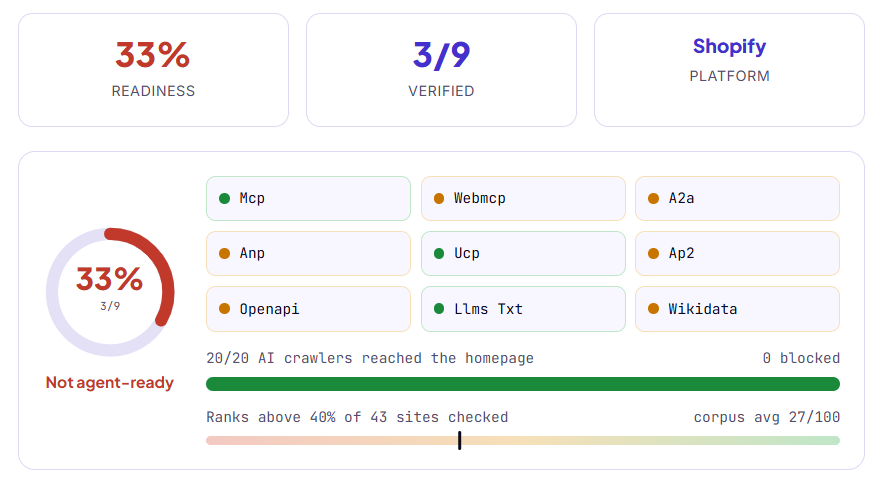
Same nine-signal check from the beauty batch, where every protocol links to its spec. Food and beverage lands like this, and each brand links to its live result.
| Brand | Platform | Agent readiness | AI crawlers reachable |
|---|---|---|---|
| Magic Spoon | Shopify | 4 of 9 | 20 of 20 |
| Death Wish Coffee | Shopify | 4 of 9 | 10 of 20 |
| OLIPOP | Shopify | 3 of 9 | 20 of 20 |
| Fly By Jing | Shopify | 3 of 9 | 20 of 20 |
| Ghia | Shopify | 3 of 9 | 20 of 20 |
| Jeni's | Shopify | 3 of 9 | 20 of 20 |
| Graza | Shopify | 3 of 9 | 8 of 20 |
| immi | Shopify | 2 of 9 | 17 of 20 |
| Omsom | Custom | 0 of 9 | 20 of 20 |
| Spindrift | Custom | 0 of 9 | 0 of 20 |
Eight of the ten are on Shopify and inherit the same three signals - a storefront MCP, UCP and an llms.txt - at the platform level, per Shopify's agentic commerce docs. immi is the exception at 2 of 9, missing its llms.txt. Every self-hosted signal - WebMCP, A2A, ANP, AP2, OpenAPI - is empty across all ten. Nobody built anything of their own.
Crawler access is not agent readiness
This is the part food DTC makes plain. OLIPOP, Fly By Jing, Ghia and Jeni's each let all twenty AI crawlers through and still score 3 of 9. Omsom lets all twenty through and scores 0. An open door means a crawler can read your pages; it says nothing about whether an agent can build a cart and check out, which is what these nine protocols actually describe. That gap between readable and buyable is the one the checkout mechanics piece traces at the transaction layer. Most of food DTC has cleared the easy half and not started the hard one.
Two brands reached 4 of 9, on the same borrowed point
Magic Spoon and Death Wish Coffee are the only two above the floor, and they got there the way the apparel leaders did: a Wikidata entity the checker matched to their domain. It is a notability signal, free to register, and the rest of the category has not bothered. No food brand self-hosted an actual protocol to earn a point - the fourth check is borrowed from being well known, not built.
Custom stacks score zero, open doors or not
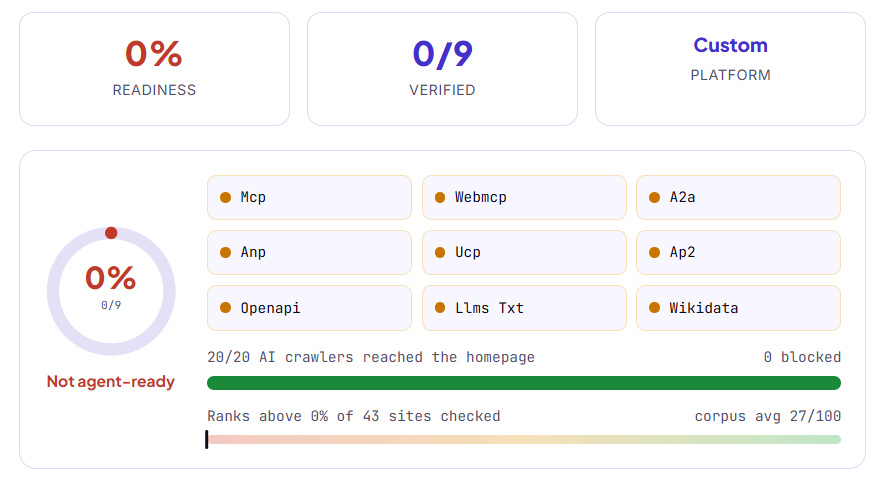
Omsom and Spindrift both run custom stacks instead of Shopify, and both score 0 of 9 - no inherited MCP, UCP or llms.txt, no Wikidata match. The tell is in the crawler column: Omsom is wide open (20 of 20) and Spindrift blocks all twenty, yet the protocol score is identical. Crawler posture and agent readiness move on separate tracks, and off-platform you start both from scratch. What the build actually takes, platform by platform, is in the platform requirements piece.
What food and beverage DTC should fix first
- Do not mistake open crawlers for readiness. Most of you already let the bots in, which is good and also just the floor. An agent still needs a protocol to transact, and none is present.
- Register a Wikidata entity. It is the one point the two leaders hold and the rest do not, and it costs nothing if your brand has any press to cite.
- Put back the llms.txt Shopify ships. immi lost its own and sits at 2 of 9 for it - the cheapest point on the board to give away.
- Self-host one real signal to clear 4. A WebMCP tool surface or an agent card is unclaimed across all ten, so shipping one puts you first in the category.
- On a custom stack, build the whole checklist yourself. Omsom and Spindrift inherit nothing; off Shopify every signal is yours to ship.
Ten brands, one vertical, checked September 1, 2026. Small sample, and a brand can restore a file or register a Wikidata item tomorrow and climb. Take it as one category on one day, and re-run any brand for its current score.
Beauty capped at 3, apparel reached 4 on borrowed fame, and food and beverage shows that a door thrown wide open to crawlers still leaves you at the same floor. Reachable is not buyable. Agentic commerce is already here, and the only question is whose product an agent can actually add to cart and buy - the way that compounds is in the pillar guide.
Run the agent-readiness checker on your store and see whether an agent gets anything past your open door.
FAQ
Are food and beverage DTC brands ready for AI agents?
Barely. In our test of ten food and beverage DTC brands on September 1, 2026, the top score was 4 of 9 (two brands), most sat at 3, and two custom-stack brands scored 0. The vertical has strong crawler access - six of ten let all twenty AI crawlers through - but that does not translate into readiness, because the protocols an agent needs to build a cart and check out are almost entirely absent. No brand self-hosted a single agent protocol.
Does letting AI crawlers in make you agent-ready?
No. Crawler access and agent readiness are separate things. In this data, brands that let all twenty AI crawlers through still scored 3 of 9, and one custom-stack brand that was wide open to crawlers scored 0. An open door lets a crawler read your pages; agent readiness is whether an agent can act on them - discover a product, build a cart, and check out through a supported protocol. Food DTC mostly cleared the first and not the second.
Why did two food and beverage brands score higher than the rest?
Magic Spoon and Death Wish Coffee each reached 4 of 9 because they have a Wikidata entity the checker matched to their domain, on top of the Shopify-inherited MCP, UCP and llms.txt. The 3-of-9 brands share the same Shopify base but lack a Wikidata match. Because Wikidata tracks notability, the extra point reflects brand recognition rather than any agent engineering the brand did.
Do custom-built stores score worse on agent readiness?
In this sample, yes. The two brands on custom stacks, Omsom and Spindrift, both scored 0 of 9, because they inherit none of the MCP, UCP or llms.txt that Shopify ships by default and had not self-hosted them. Notably, one was fully open to AI crawlers and the other blocked all twenty, yet both scored 0 - crawler posture did not change the protocol result. Off-platform, every signal has to be built by hand.
How does food and beverage compare to beauty and apparel on agent readiness?
All three sit on the same Shopify-inherited floor of MCP, UCP and llms.txt, and none had a brand self-host a protocol. Beauty topped out at 3 of 9, apparel and food both reach 4 via a Wikidata entity on their strongest brands. Food and beverage stands out only for crawler access - it blocks far less than the other two - but that access did not raise its protocol scores, which is the point: reachable is not the same as ready.