Home DTC Runs on Shopify. Three Score Below the Floor.
Every home and kitchen brand I checked runs on Shopify - all ten, no exceptions. Same platform, same free head start of a few inherited signals. Three of them still found a way to score below it, by dropping a file Shopify hands out for nothing.
All ten are on Shopify, so all ten inherit the same base: a storefront MCP, UCP and an llms.txt, for a floor of 3 of 9. Except three brands are missing the llms.txt and sit at 2, and only one cleared 4 (on a Wikidata entity). No custom stacks, almost no fame to borrow - which makes home and kitchen the cleanest look yet at what Shopify alone is worth, and at how easy it is to score under it.
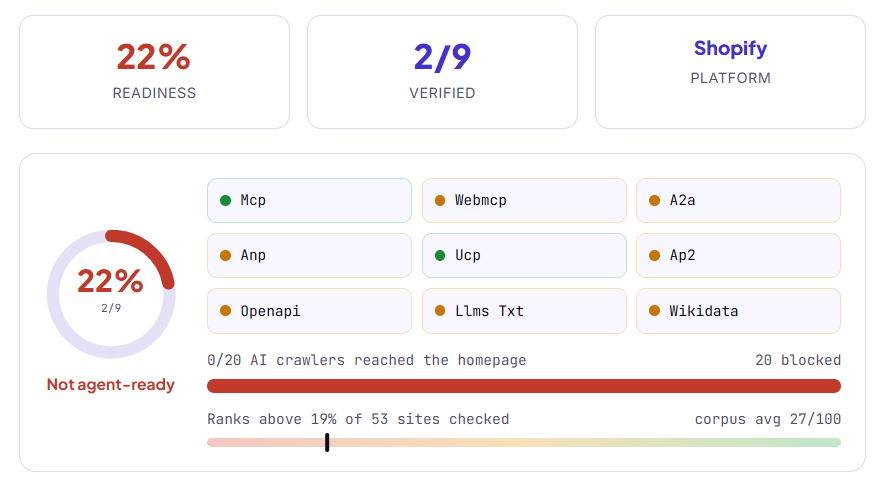
Same nine-signal check from the beauty batch, where every protocol links to its spec. Home and kitchen lands like this, and each brand links to its live result.
| Brand | Platform | Agent readiness | AI crawlers reachable |
|---|---|---|---|
| Public Goods | Shopify | 4 of 9 | 10 of 20 |
| Parachute | Shopify | 3 of 9 | 20 of 20 |
| Our Place | Shopify | 3 of 9 | 20 of 20 |
| Floyd | Shopify | 3 of 9 | 20 of 20 |
| Burrow | Shopify | 3 of 9 | 20 of 20 |
| Bearaby | Shopify | 3 of 9 | 20 of 20 |
| Brooklinen | Shopify | 3 of 9 | 9 of 20 |
| Great Jones | Shopify | 2 of 9 | 20 of 20 |
| Ruggable | Shopify | 2 of 9 | 20 of 20 |
| Caraway | Shopify | 2 of 9 | 0 of 20 |
There are no custom stacks to explain a zero here. Every one of the ten is on Shopify and inherits the same base - a storefront MCP, UCP and an llms.txt - at the platform level, per Shopify's agentic commerce docs. That should put a floor of 3 of 9 under all of them. Three brands are below it anyway, and every self-hosted signal - WebMCP, A2A, ANP, AP2, OpenAPI - is empty across the board.
Three brands scored below the free floor
Caraway, Great Jones and Ruggable all land at 2 of 9. They are on Shopify like the rest, but their llms.txt does not resolve, so they are short a signal the platform generates for free. Caraway is the worst of it: no llms.txt and a 403 to all twenty AI crawlers, failing the free file and the open door at once - the same crawler problem the food and beverage batch dug into. Scoring under the platform floor takes effort in the wrong direction.
Only Public Goods cleared 4 of 9
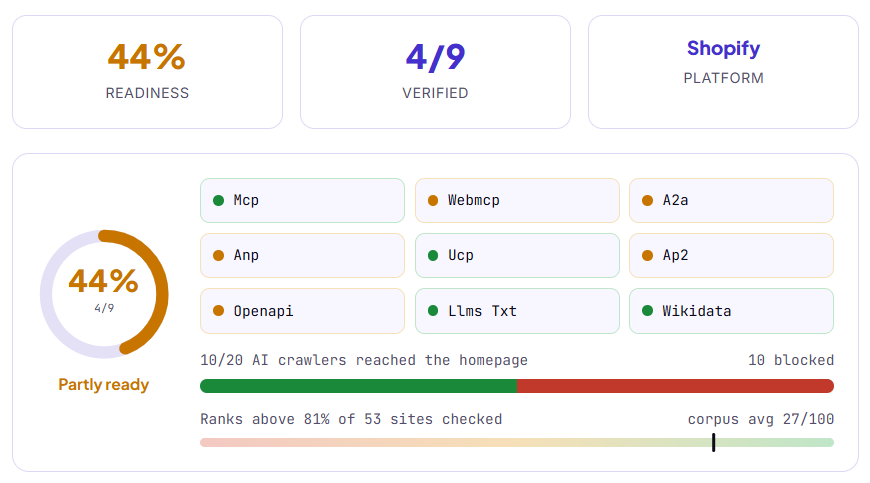
One brand broke the ceiling, and it did it the way every 4-of-9 brand in this series has: a Wikidata entity on top of the Shopify base, a notability signal rather than a self-hosted protocol. Everyone else in home and kitchen either sat on the 3-of-9 floor or slipped beneath it.
No one built past the platform
The pattern from the other verticals holds: WebMCP, A2A, ANP, AP2 and OpenAPI came back empty for all ten. Every point on this board is either handed down by Shopify or borrowed from Wikipedia. Not one home brand shipped an agent signal of its own, so the ceiling is still wide open for the first that does. What that build actually takes is in the platform requirements piece.
Get back the points you already own
- Restore your llms.txt first. Three brands here are down a free point because theirs does not resolve. It is the cheapest fix on the board and it is already the platform's job.
- Unblock your AI crawlers. Caraway pairs a missing file with a full block. Check your WAF and Cloudflare settings so an agent can at least read you.
- Create a Wikidata record. It is the only thing separating the lone 4-of-9 brand from the pack, and it is free if your brand has any press.
- Then self-host a real signal. A WebMCP tool surface or an agent card is unclaimed across all ten, so shipping one clears the ceiling instead of nudging the floor.
Ten brands, all on Shopify, checked September 3, 2026. Small sample, and a brand can restore an llms.txt or register a Wikidata item tomorrow and move. Read it as home and kitchen on one day, and re-run any brand for its current number.
Beauty coasted on Shopify, apparel borrowed from Wikipedia, food threw its doors open, and home and kitchen shows the flip side: hand every brand the same free floor and some still score under it. Agentic commerce is already here, and the only question is whose product an agent can actually add to cart and buy. The first home brand to ship a real signal owns a ceiling nobody else is reaching for - the full pattern is in the pillar guide.
Run the agent-readiness checker on your store and check you are at least holding the points Shopify already gave you.
FAQ
How agent-ready are home and kitchen DTC brands?
Weakly, and unusually uneven. In our test of ten home and kitchen DTC brands on September 3, 2026, only one reached 4 of 9, six sat at the 3-of-9 Shopify floor, and three scored below it at 2 of 9. All ten run on Shopify, so all ten inherit the same base signals, yet none self-hosted an agent protocol and three are missing a free one. It is the cleanest look in the series at what the platform alone provides.
Why did three home and kitchen brands score below the others?
Caraway, Great Jones and Ruggable each scored 2 of 9 because their llms.txt does not resolve. They are on Shopify like the rest, which normally supplies an llms.txt, so they are short a signal that is effectively free. Caraway also blocks all twenty AI crawlers, compounding the miss. Scoring under the platform floor is not about missing advanced protocols; it is about dropping a file the platform hands you.
Does Shopify give you an llms.txt automatically?
In practice most Shopify storefronts in our tests serve one, which is why the typical Shopify floor is 3 of 9 (MCP, UCP and llms.txt inherited at the platform level). But it is not guaranteed on every store: three of the ten home and kitchen brands had no resolving llms.txt and dropped to 2 of 9. Treat it as a signal to verify on your own domain rather than assume, because losing it costs a point for nothing.
Why did only one home and kitchen brand reach 4 of 9?
Public Goods was the only brand above the floor, and it got there with a Wikidata entity the checker matched to its domain, on top of the Shopify-inherited MCP, UCP and llms.txt. That is the same route every 4-of-9 brand across the series took: a notability signal, not a self-hosted protocol. No home and kitchen brand built an agent signal of its own.
How does home and kitchen compare to the other verticals on agent readiness?
It is the all-Shopify vertical, so it shows the platform floor most clearly. Beauty topped at 3 of 9, apparel and food reached 4 via Wikidata on their strongest brands, and home and kitchen also caps at 4 (one brand). What sets it apart is the downside: three brands scored below the 3-of-9 floor by missing the free llms.txt, the highest rate of that in the series. Same untouched self-hosted ceiling as every other vertical.