50 DTC Brands Tested for AI Agents. Not One Built Anything.
Over the last three weeks I ran 50 mid-market DTC brands through our agent-readiness checker - ten each across beauty, apparel, food and beverage, home and kitchen, and health and supplements. One number holds across all five verticals: the average store scores 2.6 out of 9, and every point it has was handed to it.
Across the 50, mean agent readiness is 2.6 of 9. The 43 on Shopify average 3.0; the 7 on custom stacks average exactly zero. Not one of the 50 self-hosted a single agent protocol - WebMCP, A2A, ANP, AP2 and OpenAPI came back empty every time. The only brands above the floor - 7 of 50, all stuck at 4 of 9 - got there on a Wikidata entity, not code. Agent readiness in DTC right now is whatever your platform ships you, plus a Wikipedia page if you happen to have one.
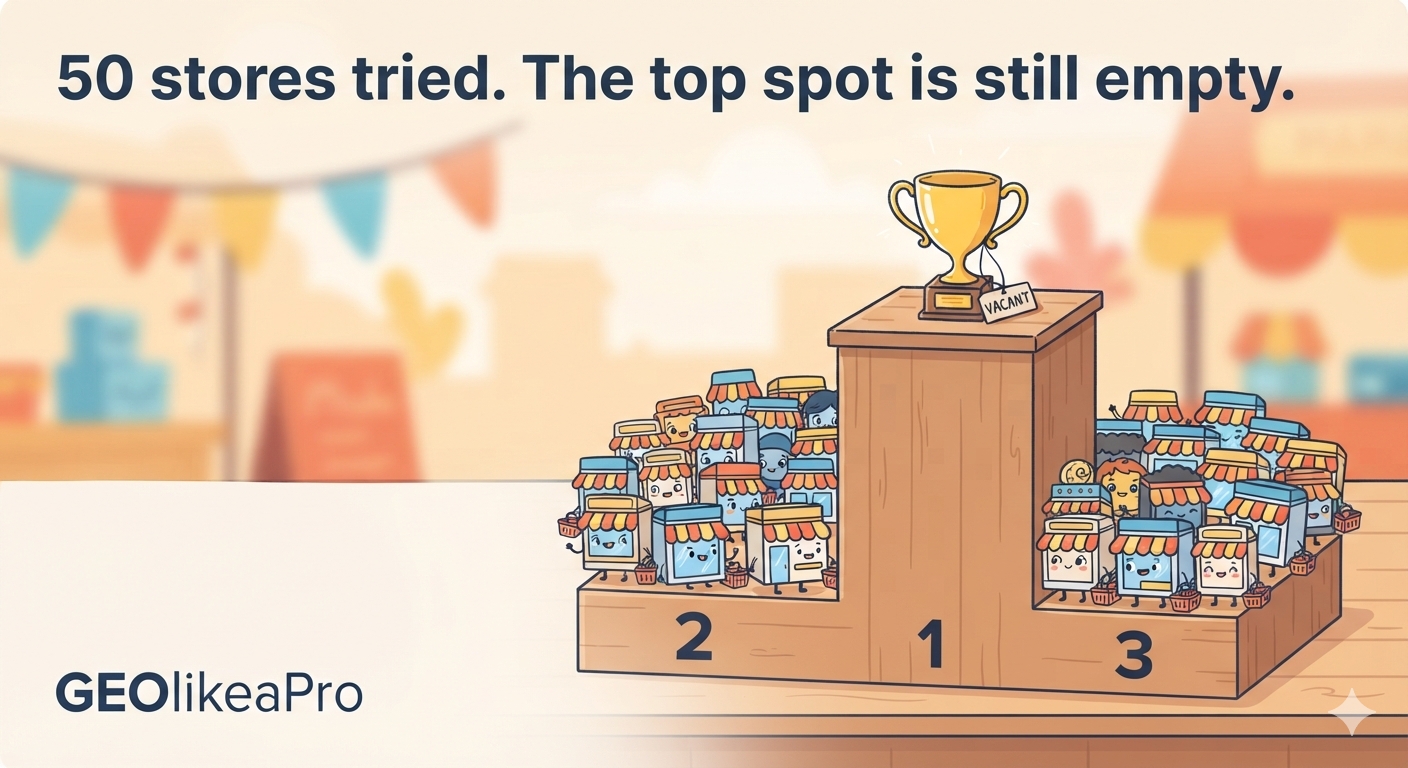
This ties together the five batch runs - each links to its full ten-brand table and every brand's live result. Here is the whole field in one view, sorted by how each vertical scored.
| Vertical | Mean readiness | Top score | On custom (all scored 0) | Blocking AI crawlers |
|---|---|---|---|---|
| Apparel & accessories | 2.9 of 9 | 4 of 9 | 1 | 8 of 10 |
| Home & kitchen | 2.8 of 9 | 4 of 9 | 0 | 3 of 10 |
| Beauty & skincare | 2.6 of 9 | 3 of 9 | 1 | 6 of 10 |
| Food & beverage | 2.5 of 9 | 4 of 9 | 2 | 4 of 10 |
| Health & supplements | 2.0 of 9 | 3 of 9 | 3 | 4 of 10 |
What 50 DTC brands score on AI agent readiness
The spread is narrow and low. Vertical means run from 2.0 (health and supplements) to 2.9 (apparel), and the individual scores bunch even tighter: 28 of the 50 sit at exactly 3 of 9, 8 at 2, and 7 at zero. Seven reached 4, and nobody in the whole set went past it. So the practical ceiling across mid-market DTC today is 4 of 9, and most of the field is a point below it.
Every agent-readiness point is inherited or borrowed
Split the 50 by stack and the story is stark. The 43 Shopify brands average 3.0, because Shopify hands every storefront the same base - a storefront MCP, UCP and an llms.txt at the platform level, per Shopify's agentic commerce docs. That is the 3-of-9 floor almost everyone sits on. The only lever anyone pulled to get above it was a Wikidata entity, which is a notability record, not a store feature. Inherited from the platform or borrowed from Wikipedia - that is the entire scoreboard.
No DTC brand self-hosted a single agent protocol
Across five emerging agent protocols, AgentThread identifies 35 specification‑level findings, supports them with 80 implementation tests against production SDKs and reference servers, and finds 30 additional failures that emerge only under protocol composition.
This is the finding that repeats in every batch and matters most.
"We’re seeing a fundamental rewiring of how DTC brands think about their digital storefronts. The brands winning in 2026 are those that treat their website as a custom‑built revenue engine, not a dressed‑up template.”
Across all 50 brands, the five self-hosted signals - WebMCP, A2A, ANP, AP2 and OpenAPI - were empty in every single case. Not one store shipped an agent surface of its own. The ceiling is wide open and untouched, so the first brand in any category that self-hosts a real signal jumps past every rival at once. What that build actually takes is in the platform requirements piece.
Custom stacks scored zero on agent readiness
Seven of the 50 run custom storefronts, and all seven scored a flat 0 of 9. No platform base to inherit, and nothing built to replace it. That is the cost of leaving the platform lane before you are ready to build the protocols yourself: an AI shopping agent finds nothing to read, add to cart or buy. If you are on a custom stack, the whole nine-signal checklist is yours to build from zero.
A quarter of DTC brands block the AI crawlers outright
The score even overstates it. Half the field - 25 of 50 - blocks at least one AI crawler at the edge, and 7 block all twenty. A brand can inherit MCP and UCP from Shopify and still 403 the agent that would use them, which is exactly what happened across beauty and health in particular. A protocol an agent cannot reach counts for nothing, so those brands are further from a sale than their number shows.
How to move your store above the DTC agent-readiness floor
- Confirm your platform floor is actually intact. If you are on Shopify you should be at 3 of 9 for free. Check that your llms.txt resolves, because a handful of brands dropped it and fell to 2.
- Open your firewall to the AI crawlers. Twenty-five of fifty block one or more. Check your WAF and Cloudflare rules so an agent can reach the protocols you already have.
- Register a Wikidata entity to clear the floor. It is the only thing that moved any brand above 3, and it is free if you have press to cite.
- Self-host one agent protocol and lead your category. A WebMCP tool surface or an agent card is unclaimed across all 50, so shipping one puts you first, not tied.
- If you run custom, budget to build all nine. You inherit nothing, so plan the whole checklist before an agent-driven sale is even possible.
Fifty brands, ten per vertical, checked across August and September 2026. Each score is one day's reading; a restored llms.txt, a new Wikidata record or a firewall change moves a brand fast. Read it as the shape of the field right now, and re-run any store for its current number.
Five verticals, fifty brands, and the same conclusion in each: agentic commerce is already here, and almost nobody has built for it. The platform hands you a floor, Wikipedia lifts a few brands one notch, and the self-hosted ceiling sits untouched. The first store in your category to build a real agent signal owns a lead nobody else is reaching for - the full pattern is in the pillar guide.
Run the agent-readiness checker on your store and see where you land against the 50.
FAQ
How agent-ready are mid-market DTC brands overall?
Barely. Across 50 mid-market DTC brands we tested in August and September 2026 - ten each in beauty, apparel, food and beverage, home and kitchen, and health and supplements - the mean agent-readiness score is 2.6 of 9. Nobody scored above 4, 28 of the 50 sat at exactly 3, and 7 scored zero. Almost the entire field is clustered at or just below the platform floor.
Did any DTC brand self-host an agent protocol?
No. Across all 50 brands, the five self-hosted signals the checker looks for - WebMCP, A2A, ANP, AP2 and OpenAPI - came back empty in every case. Every point any brand scored was inherited from its platform (a Shopify storefront MCP, UCP and llms.txt) or borrowed from a Wikidata entity. Not one store built an agent surface of its own, which leaves the ceiling open for whoever does it first.
Why do Shopify DTC brands score higher than custom ones?
Because Shopify supplies the base signals at the platform level. The 43 Shopify brands in our set average 3.0 of 9 - a storefront MCP, UCP and an llms.txt they did not have to build. The 7 brands on custom stacks average exactly zero: no platform base to inherit and nothing built to replace it. On agent readiness today, the platform is doing nearly all of the work.
How did the seven top brands reach 4 of 9?
All seven did it the same way: a Wikidata entity on top of the Shopify-inherited MCP, UCP and llms.txt. That is a notability record, not a store feature, and it was the only lever that moved any brand above the 3-of-9 floor across all five verticals. No brand reached 4 by self-hosting a protocol, and none scored higher than 4.
How many DTC brands block AI crawlers?
Half of them. Of the 50 brands, 25 block at least one of the twenty AI crawlers we test at the edge, and 7 block all twenty. This matters because a brand can inherit MCP and UCP from its platform and still return a 403 to the agent that would use them, so the protocol is effectively unreachable. Crawler blocking was heaviest in beauty and health and supplements.